
Someone still has to make the team work
AI changes the tasks. The work of coordinating people, decisions, and shared knowledge deserves a closer look.
June 24, 2026
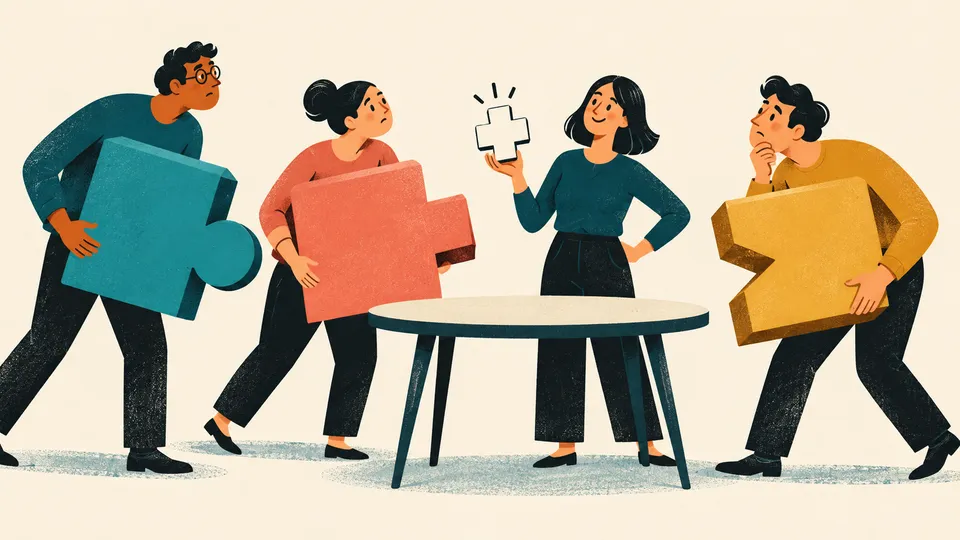
AI can make an individual task easier while creating fresh questions about how everyone works together. A study of managerial hiring, Stanford’s new workplace research lab, and the week’s employee concerns put that organizational work in focus. We think coordination deserves more respect. Someone has to decide what happens when three perfectly reasonable outputs disagree.
The manager story is more complicated than “delete the layer”
A Strategic Management Journal study links greater predictive AI adoption to more managerial vacancies in US firm data from 2010–2022, with shifts in the skills employers request.
Our take: This complicates the assumption that better technology simply removes management. It also comes from the era before widespread generative AI, so we wouldn’t use it to forecast how many managers agents will leave standing. The useful challenge is to explain what coordination, judgment, or development a management role contributes as its administrative work changes.
Stanford puts the organization under the microscope
Stanford HAI’s announcement introduces an AI and Organizations Lab studying workplace coordination, team dynamics, and organizational performance.
Our take: Good. We have plenty of impressive answers generated in a single chat window. We need a better understanding of what happens when those answers enter a team: who trusts them, who fixes them, and whether the next person can use them. A lab launch promises research; it doesn’t supply the conclusions. These are questions worth studying.
Job anxiety belongs in the rollout conversation
A Reuters/Ipsos poll of 4,531 US adults found that 53% worried AI could put them or someone in their household out of work.
Our take: That’s a finding about fear, not a forecast of job losses. It still changes the conversation a manager needs to have. “Look how much faster this is” may land very differently when someone hears “look how replaceable you are.” Explain what happens to the work after the time is saved, and be honest about decisions that haven’t been made.
Meta rediscovers the value of a stable manager
WIRED reports that Meta CTO Andrew Bosworth acknowledged mishandling an AI reorganization and promised fewer manager changes, more attention to career growth, and a cap of about 20 direct reports per manager.
Our take: An org chart can change overnight; a useful working relationship takes longer. Moving people into AI work without a clear account of their contribution or career path creates a management problem that better tools won’t fix. The interesting part of Meta’s response is the renewed attention to stable managers. Whether it restores trust is still an open question.
Skepticism can be useful design input
In a TIME opinion essay, Girls Who Code CEO Tarika Barrett argues that young people’s AI skepticism reflects a desire to help shape the technology and calls for mentorship and transparent AI policies.
Our take: We’d rather have a colleague who can name a concrete objection than one who politely applauds every demo. Ask which part of the proposed workflow they would change, and give the answer somewhere to go. Inviting people to help redesign the work gives skepticism a useful job. A listening session with no route to change will wear thin quickly.
Managing agents needs more than a software tutorial
The AI Daily Brief’s June 16 episode argues that broad AI training is needed to connect growing agent usage with enterprise value and likens managing agents to management training.
Our take: We like that last comparison more than the claim that training alone can save the economy. Teach people to define a good result, hand over enough context, notice when work has gone off course, and give useful feedback. Those are management skills with a new recipient. More token consumption is a business result for an AI lab; better work is the result a team needs.
One useful move
Find an AI conversation that produced something useful and ask:
Conversation transcript or notes: {{conversation_transcript}} Turn this conversation into a reusable prompt a colleague could understand. Include when to use it, the information it needs, and the result it should produce. Replace details specific to this conversation with clear placeholders. Keep it short and flag any context a colleague would need from me.
Fill in the missing context and save the prompt where you’d expect to find it again. One useful example is a perfectly good start.
Something fun
Recruit a manager for an unusual team:
Write a job description for the conductor of an orchestra made entirely of office printers. Include three responsibilities, one deeply unreasonable stakeholder expectation, and the interview question most likely to reveal a bad hire.
Experience handling a paper jam during the finale is preferred. Ability to distinguish an oboe from a low-toner warning is essential.
Built in the past two weeks
We added a shared prompt library and a separate collection for prompts still being tried to our team AI toolkit materials. The examples and templates spell out when to use a prompt, what context it needs, and who maintains it, so a colleague has a better starting point than a tour of someone else’s chat history.