
Make AI earn its place
AI earns its place when it has a clear job. This issue looks at useful writing tools, specialized agents, and the joy of unnecessary AI features.
April 15, 2026
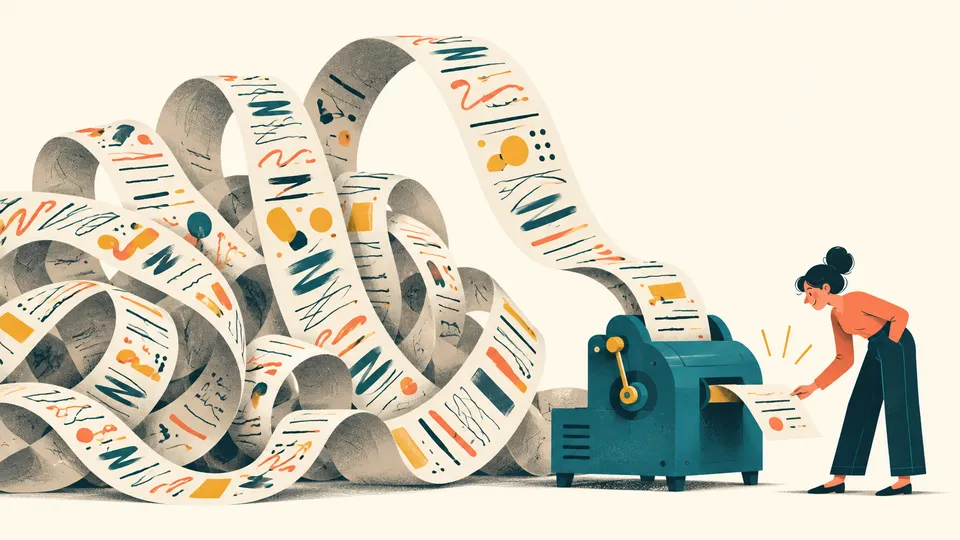
The theme this issue: make AI earn its place. Microsoft is trimming Copilot buttons, while an agent conversation puts the emphasis on specialized jobs. We see a useful connection: AI gets easier to evaluate when it has a clear purpose. “Shorten this paragraph” gives you something to judge. “Meet your new AI assistant” gives you another thing to figure out. Two more questions matter: how do we know it’s working, and which human skills must the workflow keep developing?
Notepad loses a Copilot button, keeps the AI
The Verge reports that Notepad’s Windows Insider preview swapped its Copilot button for a writing tools menu, keeping the AI features.
Our take: We should get more comfortable deleting AI buttons: “Shorten this paragraph” tells someone what help to expect, while another assistant panel asks them to figure it out. Judge the feature by whether people finish the task with less effort; more clicks could just mean retries.
Specialized agents, with room for things to go wrong
The show notes for Claire Vo’s March 29 Lenny’s Podcast appearance describe specialized OpenClaw agents and caution against installing them on a primary computer.
Our take: An agent count is a lousy success metric; tell us what each one does well and what it can break. A narrow assignment makes that easier to test, while limited permissions and separation from your everyday computer help contain the experiment.
Test each part of the automation loop
In his April 5 Lenny’s Podcast interview, Anthropic’s head of growth Amol Avasare describes an early Claude growth experiment system that separately evaluates opportunity selection, implementation, quality checks, and results analysis, with people still approving changes.
Our take: A working demo can hide a bad choice of what to build. We like breaking the loop into parts: if the code works but the proposed experiments are weak, that’s where the improvement belongs. Avasare describes small copy and interface changes here; using this approach for bigger projects means dealing with stakeholder agreement, which he identifies as a separate human job.
Keep the practice that produces judgment
In their HBR article, available as an author manuscript, Graham Kenny and Ganna Pogrebna argue that AI can weaken organizational judgment by replacing the practice and shared deliberation that develop it.
Our take: “A human reviews it” is a thin plan if nobody is learning how to spot a bad recommendation. Before handing a recurring analysis to AI, decide where people will still develop and defend their own reasoning. The authors’ example of teams documenting a strategic recommendation before consulting AI gives that learning a place in the workflow.
One useful move
Have an email draft that’s taking too long to get to the point? Give it to your usual AI tool and ask:
Email draft: {{email_draft}} Make this email shorter. Put the main request first, keep the details the reader needs, and keep it sounding like me.
Read it once to check that it still says what you mean. Then send it.
Something fun
Ask your favorite chatbot to invent the least necessary AI feature for a household object. A toaster that rewrites your breakfast goals. A kettle that schedules a stakeholder alignment meeting before boiling.
Then ask it to write the launch announcement with unbearable confidence. Our suggested opening: “For too long, socks have lacked strategic direction.”
Keep going until one idea is so ridiculous that you almost want to build it. Please give the kettle a manual override.
Built in the past two weeks
We reorganized the Mastermind guide library into frameworks, how-to guides, quick references, and workshop materials, with section indexes and a guide tracker. The aim is to give readers a useful starting point: a quick reference when you’re in the middle of a task, a how-to when you need someone to walk you through it. Small infrastructure, but worth building if it helps the next good resource get used.