
Give people better decisions
When agents do more of the execution, the human part of the workflow deserves a better brief than “click approve.”
May 13, 2026
Topics
Work design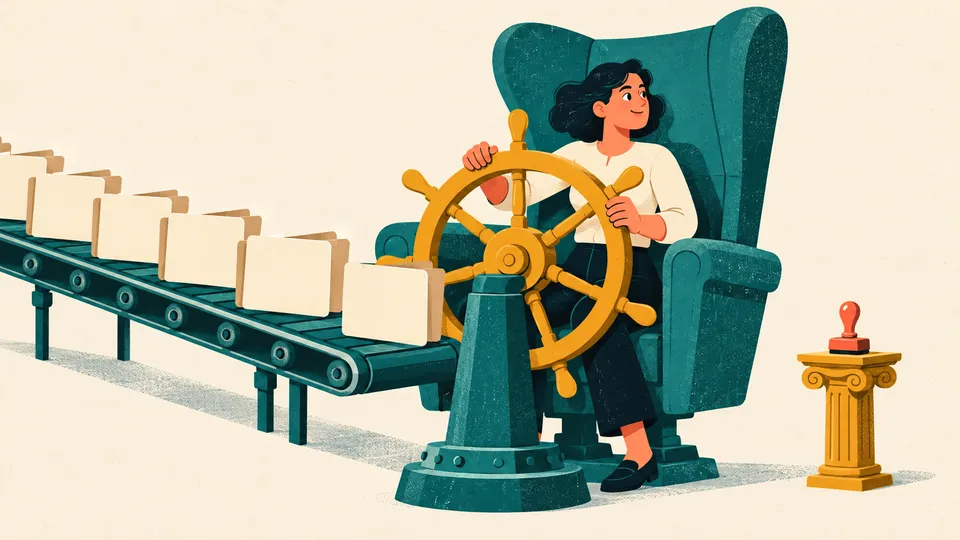
The most interesting part of an AI workflow might be the decision it leaves for a person. Workday is putting conversational AI in charge of more actions, while Ethan Mollick asks what humans should contribute when agents can do the execution. We think the design brief needs an upgrade: make the human part worth doing.
Workday gives the conversation consequences
Workday’s Sana announcement describes agents that find information and perform HR and finance tasks within its existing permissions and audit framework.
Our take: A chatbot that can update a record deserves a different conversation from one that explains a policy. We’d want to see exactly which change it proposes, who can authorize it, and how to undo a mistake. Existing permissions are useful plumbing; they don’t tell you whether someone understood the action they just requested.
Save humans a worthwhile part of the work
Ethan Mollick argues that agent workflows should give people consequential, interesting decisions that help differentiate the work.
Our take: Being the person who clicks “approve” on a conveyor belt of answers is a pretty miserable promotion. Give people room to change the brief, question the premise, and make a choice that improves the result. If their only contribution is a signature, we should be suspicious of how much judgment the process actually invites.
The writing still needs someone with something to say
Mollick also describes his growing sensitivity to familiar AI writing patterns on LinkedIn.
Our take: We wouldn’t turn a phrase into an authorship test. But a beautifully polished paragraph can still contain absolutely no point of view. Before asking AI to improve the prose, give it your actual position, a concrete example, and the thing you disagree with. Otherwise we’re all paying for the same confident beige.
A smaller workforce still needs a workable design
CNBC reports that Coinbase plans to cut roughly 14% of its workforce, about 700 employees, with CEO Brian Armstrong citing both a crypto market downturn and changes in how AI enables work.
Our take: Citing AI in a layoff announcement doesn’t establish that the remaining team can handle the work. Before making a similar call, we’d ask which tasks actually disappeared, which moved to colleagues, and who owns the exceptions. Otherwise, “AI-native” can become an expensive way to discover that coordination was work too.
One useful move
Take a draft recommendation you’re about to share and ask your usual AI tool:
Recommendation draft: {{recommendation_draft}} Read this recommendation and identify the one decision the reader needs to make. Rewrite the opening so that decision, my recommendation, and the reason for it are clear. Preserve my position and don’t invent supporting facts. If I haven’t taken a position, tell me.
Check that it still makes the case you believe. A clearer recommendation is useful even when the decision stays difficult.
Something fun
Invent an awards ceremony for phrases that have worked far too hard in business writing:
Give three overused office phrases a retirement ceremony. Write a fond but brutally honest tribute to each, followed by the plain sentence that will take over its duties.
We wish “unlock unprecedented potential” a peaceful retirement somewhere with no keyholes.
Built in the past two weeks
We drafted an AI Fluency Levels framework with five stages: Understand, Use, Guide, Integrate, and Expand. Each stage includes observable behaviors and a workplace example, giving teams a more specific way to discuss development than whether someone is “good at AI.” The draft also recognizes that the same person can be at different stages for different tasks.