AI Makes More Work Possible. Who Sets the Pace?
Faster output can become a bigger workload. Five stories on coordination, sustainable pace, and how people keep learning as AI changes their tasks.
February 16, 2026
This Lab Notes issue revisits stories from AI for HR News #001, originally published February 16, 2026.
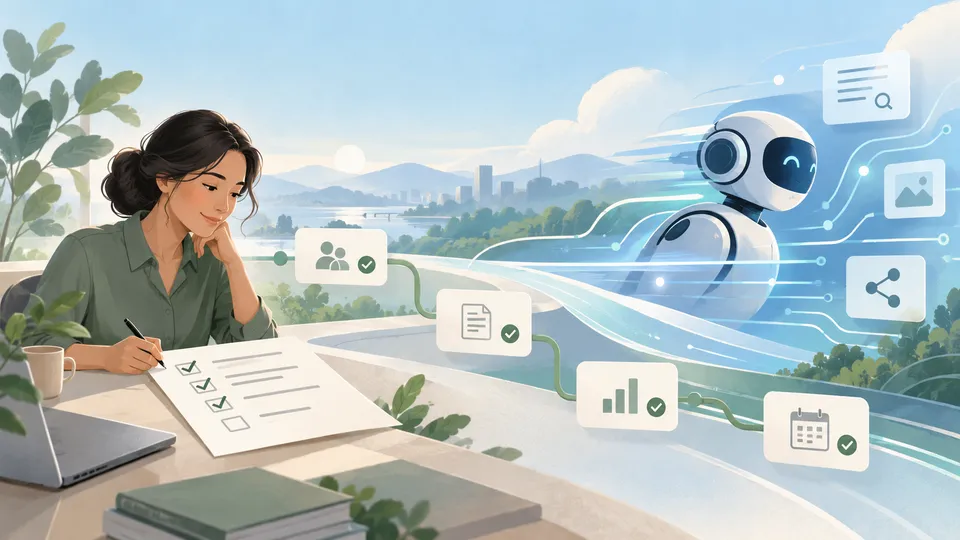
An AI tool helps someone finish a task faster. They take on another task. Their manager sees more output and adjusts expectations. Before long, the time saved has become the new workload.
That is one possible outcome of AI adoption, and it deserves as much attention as the productivity demo. Across these five stories, we keep coming back to the same questions: who coordinates the work, what pace is sustainable, and how do people keep learning as their tasks change?
News worth tracking
Your agent swarm still needs a manager
Ethan Mollick’s post on agentic AI argues that agent workflows work better when teams think about coordination and structure.
Our take: Every agent you add creates something else to coordinate. We would start with a named human owner, a clear handoff, and a decision about what happens when agents disagree; otherwise, the person supervising the workflow becomes its bottleneck.
Faster work can become a longer workday
Harvard Business Review’s account of an eight-month study describes work expanding in scope and pace as employees found it easier to take on more.
Our take: When doing more gets easier, stopping can get harder. We would make the agreement explicit before expanding a rollout: what work should disappear, what should improve, and how will the team know whether the saved time is turning into a longer day?
Where will junior employees learn the job?
Business Insider reported PwC’s move to concentrate advisory entry-level hiring in 13 offices rather than 72, linking the shift to connection, learning, and changes in work.
Our take: The useful question here is what makes apprenticeship work: access to experienced colleagues, repeated practice, and feedback on real decisions. As AI takes on junior tasks, we need to protect those learning opportunities or deliberately replace them.
Everyone does not need to become an AI power user
Daan van Rossum’s AI fluency matrix separates safe, consistent use from workflow-level practice and broader redesign.
Our take: We would define proficiency by the work someone needs to do. Safe data handling and reliable checking belong in everyone’s baseline; building workflows and redesigning operations call for different practice, support, and accountability.
Turn the big prediction into a small planning exercise
Matt Shumer’s essay, “Something Big Is Happening” makes a deliberately urgent case about the pace of AI change.
Our take: You can take the possibility of rapid change seriously without accepting every forecast. We would use the essay as a planning scenario: if AI handles more junior work, which tasks still give a new hire the experience to become good at the job?
One useful move
Take one entry-level role and list five tasks it performs regularly. For each, ask:
- Could AI help with this, and what information would it need?
- Who would check the result, and how long would that take?
- What does a junior employee learn by doing it?
Choose one task to try. Track the total time, including review and corrections, and decide how the employee will keep getting the practice that task used to provide.
A lighter thought
If your AI fluency model is a ladder, someone will eventually ask why everyone is not on the top rung. Spare your team the climbing competition. Define what good looks like for the job they actually do.
Question for the team
Where are you seeing the bigger change: a faster pace, wider job scope, or longer working hours?